You signed the lease on your new place but cannot move in for six more weeks. Your current home is packed, and your belongings need somewhere safe to go. Most people in that situation grab the first available unit without comparing their short-term and long-term options or understanding what each one actually costs them.
Choosing the right local storage solution comes down to four things: duration, access frequency, what you are storing, and budget. Perez Moving Co provides storage solutions for both options across Valdosta and South Georgia. Below, we break down costs, packing strategy, and give you a checklist to pick the right one fast.
Defining Short-Term and Long-Term Local Storage Solutions
Storage rental plans come in two forms, and most people pick one without fully understanding what separates them. Duration, access frequency, and monthly cost all work differently depending on which type you choose.
What Is Short-Term Storage?
Short-term storage covers rental periods running from a few days up to three months. Rates run higher on a monthly basis because you pay for the flexibility of a month-to-month agreement with no long-term commitment required. Most people using short-term units access them frequently, dropping off boxes, retrieving furniture, or adding items as a move or renovation progresses. Common situations include active moves, lease gaps, home staging, and remodeling projects.
What Is Long-Term Storage?
Long-term storage covers any rental that runs beyond three months, with many arrangements lasting six months to two or more years. Providers typically reduce monthly rates for extended commitments since occupancy is stable and predictable. Access frequency drops significantly, as most renters retrieve items once at the end rather than in between. Downsizing, out-of-state relocations, business inventory needs, and extended travel all fall into long-term territory.
When Short-Term Storage Is the Right Local Storage Solution
Several situations call for a flexible, short-term unit over a longer commitment, and knowing which ones apply to you saves both time and money.
Bridging the gap between leases: Renters facing a window of days or weeks between moving out and moving in need a reliable holding space without signing a long contract. Pairing short-term storage with residential moving services keeps the entire process coordinated under one roof.
Home renovation or remodeling: Contractors need clear floors and open rooms to work efficiently. A short-term unit holds sofas, beds, and dining sets safely for two to eight weeks while work gets done without damage risk.
Staging a home for sale: Decluttering before listing makes rooms photograph better and feel larger to buyers. Short-term storage holds excess furniture until the home sells without requiring permanent removal of items worth keeping.
Military PCS or temporary duty assignments: Service members across South Georgia frequently face reassignment dates that shift without notice. Flexible storage options with month-to-month terms remove the pressure of committing to a fixed rental period.
Waiting on a closing delay: New construction runs behind schedule more often than not. Short-term storage holds all packed belongings securely while buyers wait for keys without living out of boxes.
When Long-Term Storage Becomes the Smarter Storage Option
Long-term storage rental plans make financial and practical sense in situations where months pass before belongings have a permanent home again.
Downsizing to a smaller home: Moving from a four-bedroom house into a two-bedroom apartment means furniture, seasonal gear, and sentimental items no longer fit but carry too much value to donate or discard. A secure long-term unit holds everything until a permanent decision gets made.
Relocating out of state for work: Cross-country job transfers rarely come with immediate housing solutions. Belongings stay behind in a secure facility for months while the new location gets sorted, avoiding rushed decisions under pressure.
Holding business inventory and equipment: Small business owners in Valdosta and surrounding areas use warehouse storage to house seasonal stock, filing records, and office equipment without leasing commercial square footage. Combining long-term storage with commercial moving services keeps business transitions organized from start to finish.
Extended travel or caregiving situations: Someone relocating temporarily to care for a family member or spending several months abroad needs a facility that holds belongings securely without requiring monthly attention or check-ins.
Estate management after a family loss: Sorting, assessing, and distributing a loved one's belongings takes time. Long-term storage gives families months to make thoughtful decisions without rushing under financial or logistical pressure.
What Short-Term and Long-Term Storage Rental Plans Cost You
Pricing is the most searched and least answered part of any storage decision. Below are USA market ballpark ranges to give you a realistic starting point before you request a quote.
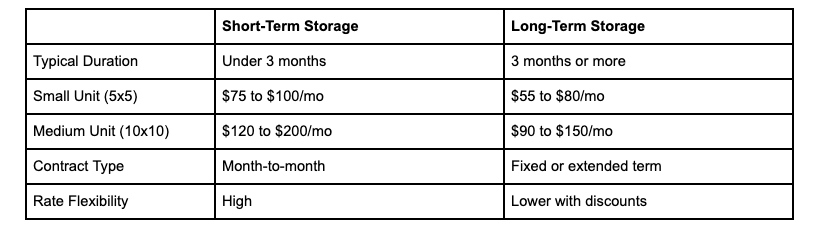
Actual rates vary by market, facility type, and unit features. These figures reflect national averages and do not represent Perez Moving Co pricing. Contact Perez Moving Co directly for a straightforward quote with no hidden fees and no surprises built into the estimate.
How to Pack for Short-Term Storage Versus Long-Term Storage
Packing strategy changes significantly depending on how long your belongings will sit in a unit. What works for a six-week gap period will not protect furniture and documents stored for eight months.
Packing for Short-Term Storage
Sturdy cardboard boxes get the job done: Items moving within a few weeks do not require heavy-duty plastic bins. Standard double-walled boxes handle the load without added cost.
Stack with retrieval in mind: Place frequently needed items at the front of the unit and rarely needed ones toward the back. Avoid having to unpack half a unit to find one box.
Basic padding covers fragile items: Bubble wrap and packing paper provide enough protection for a few weeks of stable storage. Over-engineering protection wastes time and materials at short durations.
Label all four sides of every box: Stacks hide labels on top and back. Writing on all four sides means you can read the contents from any angle without moving a thing.
Packing for Long-Term Storage
Switch from cardboard to plastic bins: Cardboard breaks down over several months, absorbs moisture, and can attract pests. Sealed plastic bins with locking lids protect contents reliably over extended periods.
Add silica gel packets to sensitive bins: Place desiccant packets inside any bin holding fabric, paper documents, photographs, or electronics to prevent moisture buildup from causing damage.
Keep furniture off the floor: Wrap wood pieces in moving blankets and set them on pallets or risers. Direct floor contact over months creates moisture transfer and increases the risk of warping.
Disassemble large furniture pieces: Breaking down beds, tables, and bookshelves reduces surface area, lowers damage risk, and frees up unit space significantly.
Photograph and inventory before sealing: Take photos of packed bins and document contents in a simple list. Memory becomes unreliable after several months away from stored belongings. Perez Moving Co's packing services can handle preparation if you want professional hands managing fragile or high-value items.
Long-Term Packing Materials Checklist
Heavy-duty plastic bins with locking lids
Silica gel desiccant packets
Furniture moving blankets
Stretch wrap for upholstered items
Pallet boards or floor risers
Permanent markers and color-coded labels
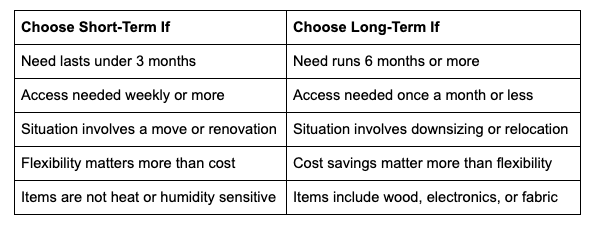
A Quick Decision Checklist to Pick the Right Storage Option
Match your situation to the right column and your answer becomes clear.
Ready to Choose Between Short-Term and Long-Term Storage?
Short-term and long-term storage each serve a distinct purpose, and neither option is universally better. Duration, how often you need access, and what you are storing determine which one actually fits your situation.
Perez Moving Co serves Valdosta and communities across South Georgia with secure, climate-controlled units and straightforward pricing on both options. Call 229-415-7670 or visit storage-solutions to get a free, no-pressure quote and find out exactly which plan works for your timeline.
FAQs
What is the difference between short-term and long-term storage?
Short-term storage covers rental periods up to three months with month-to-month terms, while long-term storage runs beyond three months and typically offers lower monthly rates for extended commitments.How much does a storage unit cost per month?
Monthly rates across the USA range from $75 to $200 for short-term units and $55 to $150 for long-term agreements, depending on unit size, location, and whether climate control is included.Do I need a climate-controlled unit for long-term storage?
Wood furniture, electronics, fabric, and documents all benefit from climate control during long-term storage, particularly in South Georgia where heat and humidity cause real damage over several months.Can I switch from short-term to long-term storage if my plans change?
Many providers allow customers to convert a month-to-month agreement to a long-term rate once a longer commitment becomes clear, though policies vary by facility and asking upfront protects you.How do I know what size storage unit I need?
A 10x10 unit holds most one-bedroom apartment contents, while a 10x20 accommodates a two-bedroom home. Requesting a walkthrough quote gives you the most accurate sizing recommendation.